Introducing TunnelMesh
Today we're open-sourcing TunnelMesh, a P2P mesh networking tool built in Go that creates encrypted tunnels between nodes using the Noise IKpsk2 protocol with ChaCha20-Poly1305 encryption.
Why Another VPN?
Traditional VPN solutions require hub-and-spoke topology: all traffic flows through a central server. This creates a single point of failure, adds latency for geographically distributed nodes, and limits throughput to what the hub server can handle.
TunnelMesh is built differently. Every peer connects directly to every other peer whenever possible, falling back to relay only when NAT prevents direct connectivity. The result is a fully-meshed network where bandwidth scales with node count rather than bottlenecking at a central server.
The Noise Protocol
At the heart of TunnelMesh is the Noise Protocol Framework, specifically the IKpsk2 handshake pattern. This gives us:
- Mutual authentication: both peers verify each other's identity using static Diffie-Hellman keys derived from SSH keys
- Forward secrecy: ephemeral keys ensure past sessions can't be decrypted even if long-term keys are compromised
- Pre-shared key mixing: an additional layer of authentication that ties peers to a specific network
All session traffic is encrypted with ChaCha20-Poly1305, a modern AEAD cipher that performs well on hardware without AES acceleration (common in embedded devices and older ARM chips).
Architecture
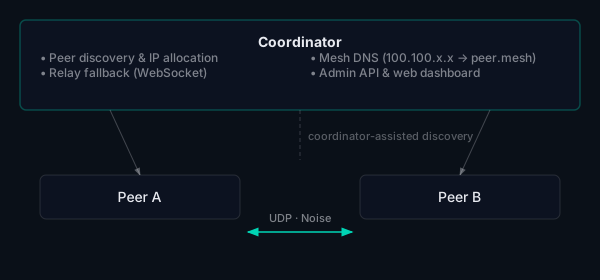
Each peer runs a TUN interface that handles transparent IP routing. Packets destined for mesh IPs (100.64.0.0/10) are captured by the TUN device and routed through the appropriate encrypted tunnel.
Transport Fallback Chain
Getting peers behind NAT to talk directly is the hard part. TunnelMesh uses a three-level fallback:
- UDP: Direct peer-to-peer with hole punching. Sub-millisecond overhead on LAN, works through most consumer NAT.
- SSH: TCP-based fallback that traverses stricter firewalls. Uses the existing SSH infrastructure many nodes already have.
- WebSocket relay: Last resort. Traffic is relayed through the coordinator's WebSocket server when direct connectivity is impossible (symmetric NAT, corporate firewalls).
What's Included
The initial release ships with:
- Full mesh P2P networking with automatic NAT traversal
- Mesh DNS resolution (
peer-name.mesh→100.64.x.x) - Zero-trust packet filtering (default-deny with rule-based allow)
- S3-compatible object storage shared across the mesh
- NFS file sharing over the mesh
- Docker integration with automatic port-forward rules
- Prometheus metrics + Grafana dashboards
- Terraform modules for DigitalOcean deployment
Getting Started
Check out the Quick Start Guide to get your first mesh running in under 10 minutes.
# Download the latest release
curl -L https://github.com/tunnelmesh/tunnelmesh/releases/latest/download/tunnelmesh-linux-amd64.tar.gz | tar xz

# Start a coordinator
sudo ./tunnelmesh coordinator --config coordinator.yaml

# Join from another node
sudo ./tunnelmesh join --coordinator https://your-coordinator:8443 --token your-token
What's Next
We're actively working on:
- Multi-coordinator federation: mesh clusters that span organizational boundaries
- Improved observability: per-flow latency histograms and packet loss metrics
- Policy-as-code: declarative filter rules managed through GitOps
Follow the GitHub repository for updates, and open issues for bugs or feature requests.
TunnelMesh is released under the AGPL-3.0 License.