The Noise Protocol: How TunnelMesh Handles Encryption
Before two TunnelMesh nodes can exchange a single encrypted packet, they need to shake hands. Not the social kind: a cryptographic handshake where both sides prove who they are and agree on secret keys that nobody else will ever know.
TunnelMesh uses the Noise Protocol Framework for this. Here's what that actually means.
Why Not Just Use TLS?
TLS is what your browser uses to talk to websites. It works great for that. For a mesh VPN, it brings a lot of baggage:
- You need certificates: a Certificate Authority to issue them, a process to renew them, somewhere to store them
- TLS negotiates cipher suites and protocol versions, which means more code and more things that can go wrong
- TLS was designed for client-server connections, not peer-to-peer
Noise is a framework for building exactly the handshake you need and nothing else. You pick a pattern from a catalogue, name your algorithms, and the spec tells you exactly what bytes go over the wire and exactly what security properties you get. No surprises.
The Pattern: IKpsk2
TunnelMesh uses the IKpsk2 pattern. The name is a recipe:
I   = the initiator sends their static key in message 1 (encrypted)
K   = the responder's static key is already known to the initiator
psk2 = a pre-shared key is mixed into message 2
After two messages (one from each side), both peers have:
- Verified each other's identity via their long-term keys
- Agreed on fresh session keys using ephemeral (one-time) key pairs
- Bound themselves to the same network via the pre-shared key
That third property is important. Even if an attacker has a valid TunnelMesh keypair from a different network, the PSK check will reject them. You can't join a mesh you weren't given a token for.
Where the Keys Come From
Every machine in a TunnelMesh network has a static key: its long-term identity. Rather than generating a separate set of keys, TunnelMesh derives this from the machine's SSH key:
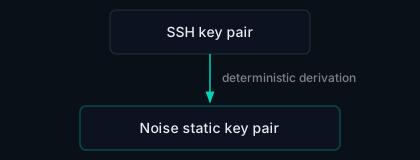
tunnelmesh init handles this. If you'd rather reuse an existing SSH key, point the config at it.
The coordinator stores everyone's public keys. Private keys never leave the machine.
What Happens After the Handshake
Once the handshake completes, both sides have symmetric session keys. All traffic from that point on is encrypted with ChaCha20-Poly1305, a modern cipher that authenticates every packet, so a modified or replayed packet is detected and dropped immediately.
The session keys are derived from the handshake transcript, not from the long-term keys directly. This means:
If your long-term key is ever compromised, past sessions are still safe. The session keys are gone and can't be reconstructed.
This property, called forward secrecy, is one of the main reasons to use Noise over simpler approaches.
The Coordinator's Role
The coordinator helps peers find each other's public keys and facilitates relay when direct connections fail. It's not in the encryption loop. The coordinator never sees session keys and cannot decrypt any traffic between peers.
TunnelMesh is released under the AGPL-3.0 License.