Why We Built TunnelMesh
It started, as these things do, with a lazy Sunday afternoon that turned into a four-hour debugging session.
We had a few machines spread across home networks, a VPS, and a rented server. Nothing exotic. We wanted them to talk to each other securely: private IPs, encrypted traffic, no relying on a third party. Simple enough, right?
The Hub-and-Spoke Trap
Most VPN tools are built around a hub-and-spoke model. Think of it like a wheel:
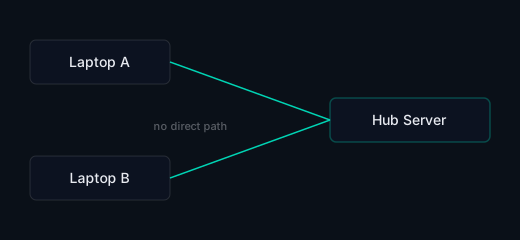
Every packet between Laptop A and Laptop B travels through the hub, even if they're on the same LAN. That hub is your central server: the one you're paying for, the one that becomes a bottleneck, and the one that takes everything down when it has a bad day.
We didn't want a wheel. We wanted a mesh.
What We Actually Wanted
After a few frustrating evenings we wrote down what the tool needed to do:
- Self-hosted: our data, our coordinator, no cloud subscription required
- Direct connections: peers talk to each other peer-to-peer when possible, relay only as a last resort
- Modern crypto: the Noise Protocol, not a hand-rolled cipher or ageing TLS configuration
- No new keys to manage: use the SSH keys that are already on every machine
- Default-deny networking: being on the mesh shouldn't mean trusting everyone on the mesh
We looked at the options. WireGuard has excellent crypto but no built-in peer discovery; you're editing config files and distributing keys by hand. Tailscale ticks most boxes but isn't fully self-hosted. ZeroTier has its own crypto. None of them felt like the right foundation.
Starting From the Noise Spec
We started from a protocol rather than from a product.
The Noise Protocol Framework gave us a handshake pattern (IKpsk2) with mutual authentication, forward secrecy, and network binding built in. ChaCha20-Poly1305 for encrypting the actual traffic, fast on ARM chips, with no timing side-channels. Derive the identity keys from each machine's existing SSH key, and suddenly every box already has a cryptographic identity.
On top of that we built the thinnest coordinator we could: it hands out IP addresses, helps peers find each other, and provides relay as a fallback. It can't read anyone's traffic.
The First Test
The first end-to-end connection was two laptops on different home networks, 2ms round-trip, direct UDP, everything encrypted. That took a weekend.
The next several weeks were the hard part: symmetric NAT, corporate firewalls, the edge cases that turn "it works on my network" into "it works reliably everywhere." The three-level transport fallback (UDP → SSH → WebSocket relay) exists because of those edge cases.
But that first working connection was enough to know the idea was sound.
TunnelMesh is released under the AGPL-3.0 License.